The rise of autonomous AI agents doesn’t make architecture obsolete. It makes it existential.
From Railways to Jazz Bands
Until now, we’ve been automating tasks with tools like n8n, Power Automate, or Zapier. The principle is always the same: you define a trigger, build a chain of actions, handle exceptions with conditional branches, and the system executes. Reliably. Deterministically. Predictably.
You build the tracks. The train follows them. If the tracks end or something unexpected blocks the path, the train stops. Someone has to build new tracks.
This is powerful. It has transformed how organizations handle repetitive processes. But let’s be clear about what it is: the intelligence lives in the design. Even when you integrate an LLM into the workflow, the agent operates within the boundaries you’ve defined. It can reason within the rails – but it doesn’t leave them.
Now look at what’s happening with OpenClaw – the open-source AI agent framework that’s gaining massive traction right now (created by Peter Steinberger).
OpenClaw works fundamentally differently. You don’t define the path. You give it a goal. The agent figures out the steps. It reasons about what tools to use, which APIs to call, what information to gather. It opens your browser, configures API keys, coordinates across systems, and adapts when something unexpected happens. Users report that it sets up APIs, builds workflows, and navigates complex tasks – all without predefined instructions.
This is not a faster railway. This is a fundamentally different mode of operation.
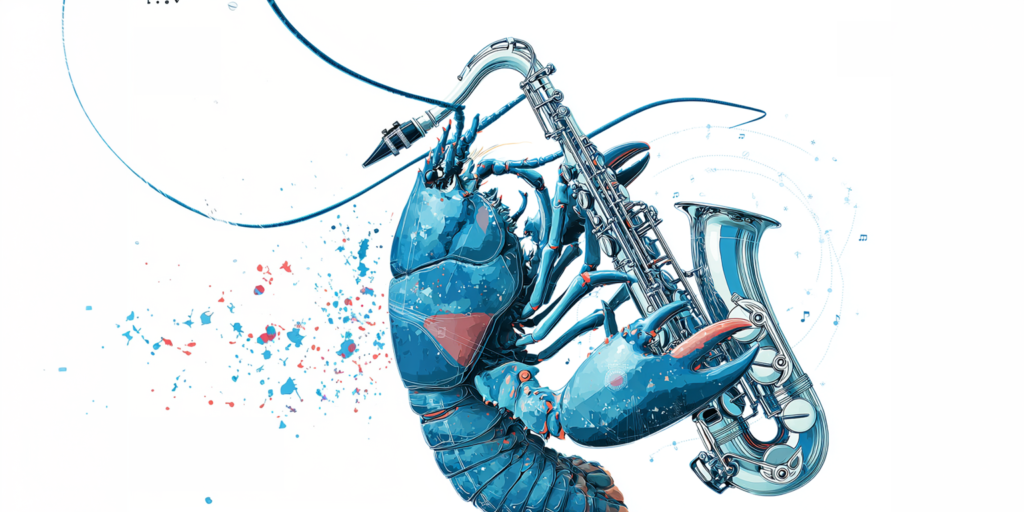
If a classical workflow is an orchestra – every musician playing exactly what’s written on the sheet, note by note, bar by bar – then OpenClaw is a jazz band. The musicians improvise, react to each other, create something new in the moment. No two performances are the same.
But here’s what most people miss about jazz: it only works because every musician knows the key, feels the rhythm, and understands the piece. Without that shared foundation, improvisation isn’t jazz. It’s noise.
And that distinction has profound implications for Enterprise Architecture.
The Paradigm Shift
Let me be precise about what’s shifting here, because the difference matters architecturally.
The old world: We define processes. Tools execute them. A human designs every decision point, every branch, every exception path. The system follows the script. If you need new behavior, you build a new workflow. Control is total. Flexibility is zero.
The new world: We define goals. Agents collaborate to achieve them. The agent reasons about what steps are needed, decides which tools to use, handles exceptions autonomously, and coordinates with humans when judgment is required. Control is shared. Flexibility is high.
This isn’t an incremental improvement. It’s a paradigm shift in the relationship between humans and technology – from command-and-execute to goal-and-collaborate.
And it raises a question that most technology discussions are overlooking:
If the agent can figure out its own path, do we still need architecture at all?
The Counterargument
The argument sounds compelling at first: If an autonomous agent like OpenClaw can navigate freely – pulling data from any system, calling any API, finding its own way through the enterprise landscape – then why bother with carefully modeled ontologies, end-to-end process designs, and collaboration frameworks? The agent improvises. It doesn’t need predefined tracks.
This reasoning is fundamentally flawed. Here’s why.
An agent can find information. But it cannot know whether that information is correct, whether it’s current, whether it stands in the right context, or whether it’s authorized to act on it.
Picture this: an agent is tasked with preparing a site selection recommendation. It finds revenue data in one system, cost projections in another, workforce availability in a third. It synthesizes and delivers a confident, data-driven recommendation. Impressive.
But what if the revenue data uses a different regional taxonomy than the cost projections? What if the workforce data hasn’t been updated in six months? What if the agent accessed a system it shouldn’t have, violating compliance boundaries nobody thought to define for non-human actors?
The agent won’t fail because it can’t find the data. It will fail – or worse, cause harm – because the data it finds is inconsistent, outdated, or contextless.
Autonomy is not the same as competence. An agent moving autonomously through a chaotic data ecosystem isn’t more capable. It’s more dangerous. It automates chaos at higher speed.
Three Stages of Architectural Evolution
This is where the real insight lies. With each generation of technology actors, the need for architecture doesn’t decrease. It intensifies.
Stage 1 – Classical IT: Structure for humans. We build systems, databases, and interfaces so that people can work efficiently. When data is inconsistent or processes are unclear, humans compensate. They pick up the phone, ask a colleague, work around the problem. The cost of poor architecture is inefficiency – but humans absorb the impact.
Stage 2 – Workflow automation: Structure for deterministic systems. We build automated workflows that follow predefined paths. When data is missing or formats don’t match, the workflow breaks. It stops. Someone gets an error notification. The cost of poor architecture is visible – a failed workflow, a stuck process. Annoying, but containable.
Stage 3 – Agentic AI: Structure for autonomous agents. We deploy agents that find their own paths, make their own decisions, and act autonomously. When data is inconsistent or ontologies are unclear, the agent doesn’t stop. It improvises. It finds a way – some way. The cost of poor architecture is invisible – wrong decisions made with high confidence, at high speed, at scale.
With each stage, the autonomy of the actor increases. And with each stage, the need for clean, collaborative architecture increases. Not less. More.
More Autonomy, More Architecture
Think about a city.
When everyone walks, dirt paths are sufficient. People navigate around obstacles, find shortcuts, adapt intuitively.
When cars arrive, you need roads, traffic signs, and rules of the road. The increased speed and power of the new actor demands more infrastructure, not less.
When autonomous vehicles arrive, you need even more precise infrastructure – HD maps accurate to the centimeter, sensor networks, real-time vehicle-to-vehicle communication, edge cases modeled and governed.
No one would argue that autonomous driving makes road infrastructure obsolete. The opposite is true: the more autonomous the actor, the more sophisticated the infrastructure must be.
The same logic applies to Enterprise Architecture.
An autonomous AI agent navigating your enterprise landscape needs cleaner ontologies than a human ever did – because unlike a human, it can’t call a colleague to ask “what did you actually mean by this data field?” It needs clearer process boundaries – because unlike a workflow, it won’t stop at the edge of its defined scope. And it needs explicit governance – because unlike a rule-based system, its decisions aren’t deterministic and therefore can’t be audited by simply reading the workflow definition.
From Nice-to-Have to Non-Negotiable
In my previous articles in this EA Manifesto series, I’ve argued that Enterprise Architecture is fundamentally about collaboration – about understanding and designing how things relate to each other. Not just technically, but organizationally.
The rise of autonomous agents makes this argument urgent.
For agent-driven decisions to work, organizations need clarity on three things before deploying agents:
First – a shared purpose. What are we optimizing for? Not “what does each department want,” but “what is the best outcome for the organization as a whole?” This must be explicitly defined because the agent needs it as its objective function. You can no longer afford to be vague about your purpose.
If Sales gives its agent the goal “maximize proximity to my top accounts,” Production gives its agent “minimize investment in my area,” and Finance gives its agent “optimize tax position” – you get three agents working against each other. Each optimizing for its silo. The result isn’t better than the old political power struggle. It’s worse – because it happens faster and carries the authority of “data-driven analysis.”
Second – a shared ontology. What do we mean by “optimal”? Which criteria matter? How are they weighted? If Sales, Production, and Finance use different definitions of “site quality,” the agents will deliver contradictory results – each internally consistent, each confidently presented, each fundamentally incompatible with the others.
The shared language that Enterprise Architecture creates – taxonomies, relations, assessment criteria – becomes an operational necessity. Not a documentation exercise. A prerequisite for AI agents to function coherently.
Third – transparent decision rights. Who is authorized to give the agent which objective? Who arbitrates when agent recommendations conflict? Who is accountable when an agent acts on flawed data?
This is governance in its purest form. And it must be architecturally modeled and enforced – not buried in a policy document that no one reads.
The Foundation That Makes It Possible
Here’s what makes this moment transformative – and why I believe it represents a genuine opportunity, not just a risk.
In the old model, departments could hide their individual agendas behind complexity and political maneuvering. Silo thinking, information hoarding, ego-driven decisions – they were invisible because they were woven into the fabric of human organizational behavior.
In the new model, these agendas become visible. They manifest in the objective functions of the agents. When three agents optimize in three different directions, everyone can see immediately: we don’t have a shared goal. We’re not collaborating. And that’s no longer a soft-skill problem. It’s an architectural failure.
This is why collaboration has moved from aspiration to requirement. “Better collaboration” used to be a nice goal on the town hall slide. Now it’s the technical prerequisite for your AI investments not ending in chaos.
But the good news is: Enterprise Architecture, collaboration, and a shared purpose can provide that foundation. Together, they create the conditions under which autonomous agents don’t just function – they thrive. And so do the humans working alongside them.
Your architecture today determines what’s possible with AI tomorrow. Make it count.
Based on my EA Manifesto series exploring the intersection of philosophy, collaboration, and enterprise architecture. Previous articles examined why EA is fundamentally about ontologies and why collaboration is the infrastructure layer every business model depends on.
What’s your experience? Are your organizations preparing their architectures for autonomous agents – or are we still writing sheet music for a world that’s already improvising?