
Purpose. Vision. Mission. Strategy.
To What End?
Before we can architect anything, we need to understand what we are architecting for.
This is true for Enterprise Architecture, but it is equally true for products, for teams, for entire organizations. Before we build, we must know why we are building. Before we optimize, we must know what we are optimizing toward. Before we act, we must understand what our action is meant to achieve.
This is the third pillar of Enterprise Architecture as a discipline of collaboration. After exploring the nature of collaboration itself and understanding what organizations truly are, we arrive at the question that precedes all architectural work: Where are we going? And why does it matter?
The Economic Logic of Purpose
Organizations exist to create value for customers. This requires people to come together around a shared purpose, working collaboratively toward common goals. This is not idealism – it is the basic economic logic of why organizations exist at all.
Without a shared destination, there is no journey – only movement.
The Cost of Strategic Absence
Yet many organizations operate without clear strategic direction. The cost is not abstract – it manifests in concrete business results. Redundant systems multiply because departments will not collaborate without shared goals. Integrations fail because information hoarding protects local interests. Market opportunities slip away while internal battles consume attention. Good people leave, exhausted by dysfunction that produces activity but not meaning.
Bob Sutton, Professor Emeritus at Stanford University, documented what organizational dysfunction really costs – not in culture, but in hard currency. It runs into billions.
Why does this happen? Fear of commitment – clear vision creates accountability, and ambiguity provides cover. Artificial competition – silos compete for resources rather than collaborating for outcomes. Short-term incentives – why invest in direction when you are measured quarterly? And beneath all of these: without strategy, individuals are free to prioritize personal gain over collective purpose.
The Cult of Doing
But there is something deeper at work. We live in an era that worships action. 80% execution, 20% planning. Just start. Done is better than perfect. The message is clear: thinking is a luxury, reflection is a waste of time, only output counts.
This mindset has become so ingrained that strategic thinking seems almost suspicious. Those who pause do not produce visible output. And in organizations measured quarterly, invisible work is dangerous work. So: movement above all.
But here is the paradox: if you “just do”, how do you know you were successful? Against what do you measure? It is the essential question Simon Sinek keeps asking: To what end? Without an answer to that question, action becomes self-referential – we do because we do.
To lead means to know where to go. Strategy is leadership.
What we observe is a threefold confusion: Speed is confused with progress – fast action feels productive, even when it leads in circles. Execution is seen as the opposite of strategy – as if we had to choose. But the choice is false. Strategy without execution is fantasy. Execution without strategy is chaos. And activity serves as alibi – those who set direction can fail visibly, while those who “just do” can always claim they did something.
The result is a culture of exhausted busyness. People work harder than ever – and still wonder what for. The thinking that gives action its meaning has been rationalized away. As if it were optional. As if meaning were a nice-to-have.
It is not.
The Pattern
This is not theory. We have seen this pattern before.
Kodak invented digital photography – then stuck with film because the core business was too profitable to question. Nokia dominated mobile phones – then dismissed the smartphone as a niche. Blockbuster had the chance to buy Netflix for 50 million dollars – and declined because the stores were “still working”.Blackberry treated the physical keyboard as sacred – the market disagreed.
None of these companies lacked resources, talent, or information. What they lacked was the willingness to think strategically while the operational machine was still running. They optimized what was, instead of asking what should be.
Execution was excellent. Direction was absent.
Let us name the elephant in the room: these companies never saw the whole elephant. They optimized pieces – products, processes, quarterly results – without understanding how they fit together.
It makes sense to cut the elephant into pieces and break down complexity into manageable steps. But you need to know the elephant first. “Think big, start small” only works if you have actually thought big. Otherwise, you are just cutting blind – and wondering later why the pieces do not fit.

Thinking from the End
So how do we build strategic clarity? One powerful approach is to invert our perspective: think backward.
Stand in the future. Look at the path that brought you there. What had to be true? What decisions were made? What capabilities were built?
Futurist Matthias Horx calls this method “Regnosis” – the inversion of prognosis. While prognosis projects forward from today, often into fear and constraint, regnosis places us in the future looking back. The question shifts: not “Why is this impossible?” but “How did we get here? How did we make it work?”
This forces us to define the destination before we plan the route.
Remember: strategy is not a rigid five-year plan. Strategy is a destination. Like stepping into a taxi – the address is clear, but the route can change. Traffic jams require alternative paths. Unexpected stops add detours. Throughout all tactical adjustments, the destination remains fixed. Strategy provides direction; tactics provide the path.
This is precisely why volatile, uncertain environments demand more strategic clarity, not less. When everything changes rapidly, we need direction even more desperately.

The Architecture of Purpose
Strategic thinking follows a natural hierarchy. Vision sits at the apex – the picture of what could be, the aspiration that inspires. Mission describes how we pursue it, what we do and for whom. Values define how we work together along the way. And Strategy translates all of this into concrete direction – the goals that operationalize our purpose.
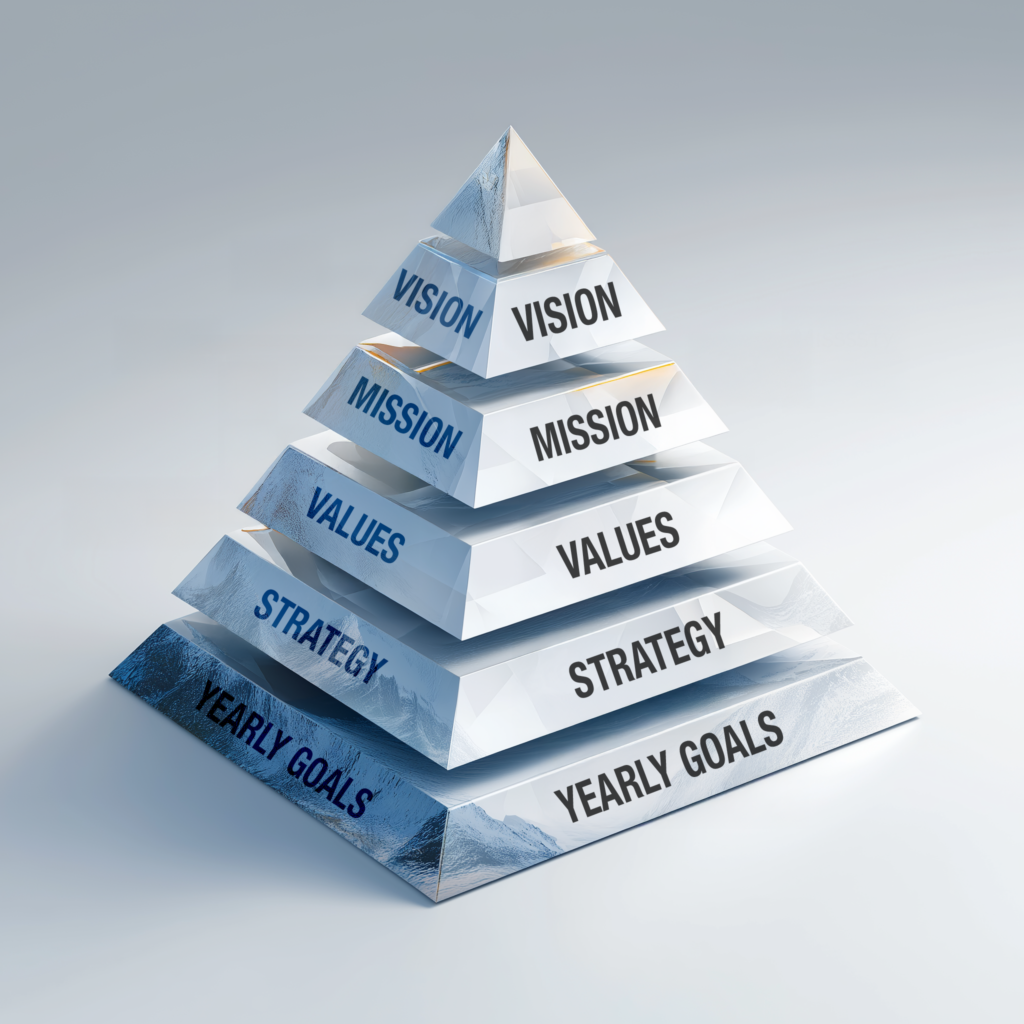
This is not bureaucratic exercise. Without shared purpose, every interaction becomes negotiation. With it, collaboration flows naturally toward common goals.
EA at the Intersection
This is where Enterprise Architecture becomes essential. We cannot design good architectures without understanding organizational purpose. We cannot model value streams without knowing what value means. We cannot make trade-off decisions without strategic direction.
Strategy without operations is words on paper. Operations without strategy is blind running. EA sits at the intersection – translating strategy into operational reality, and in doing so, creating the conditions for meaningful collaboration.
But EA can only translate what exists. If there is no strategy to translate, architecture becomes decoration – impressive diagrams that connect nothing to nothing.
The Choice
Prof. Dr. Dirk Stein predicts that the CEO of the future will be an AI – building on the concept of Prof. Dr. Tobias Kollmann. That may sound provocative. But it is merely the logical consequence of a development we ourselves are initiating.
When we shy away from the work of thinking. When we dismiss vision as a waste of time and see strategy as an obstacle. When we prefer doing to understanding – a vacuum emerges. And vacuums get filled.
AI systems can analyze, optimize, decide. What they cannot do: act from conviction. Have ideas born from experience and values. Want a future, not merely calculate one.
This is what is actually at stake. Not whether AI will take over tasks – it will. But whether we retain the tasks that make us human: Setting goals. Articulating meaning. Deciding what is worth working for.
The Foundation Stands
A clear strategy, derived from vision and mission, translated into concrete achievable goals, creates clarity and meaning. It prevents the drift toward personal agendas and political maneuvering. It aligns the forces of the collective toward shared outcomes.
This is the foundation. Not because it sounds inspirational, but because without it, we cannot build anything that lasts. Enterprise Architecture, ultimately, is about building things that endure – organizations that create value, systems that enable collaboration, structures that serve human flourishing.
Purpose is not optional. Purpose is the foundation.
Those unwilling to build it may keep the driver seat. But the destination will be determined by someone – or something – else.